Iron Messenger
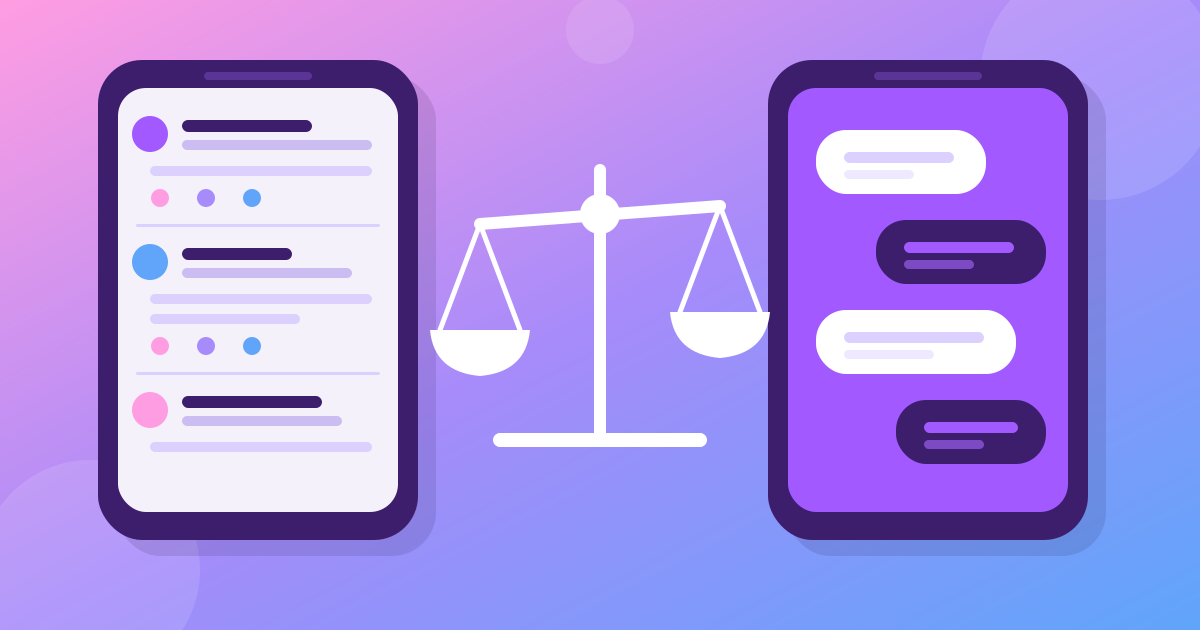
Threads and Telegram are not the same kind of app. Threads is Meta's feed of short public posts, built to follow people and join the conversation around them, and Telegram is a messenger with chats, groups, channels and bots. Pick Threads to follow and talk to the public, and Telegram to message people and to read or run channels. If you want private chats, groups and channels without a phone number, Iron Messenger is a third option, with honest limits that this post lists.
What is the difference between Threads and Telegram?
The two apps answer different questions. Threads answers "what is everybody saying right now?". Telegram answers "how do I talk to these people, or read this one source?".
Threads is made by Meta and lives next to Instagram. You write short text posts, other people reply, like and repost, and the app builds you a feed. At the time of writing (November 2026) it also has an opt-in setting that shares your public posts with Mastodon and other ActivityPub networks, which Meta introduced as a beta. Messaging is the newer part: direct messages reached every user in July 2025, group chats of up to 50 people followed in October 2025, and messaging came to the web in May 2026.
Telegram is a cloud messenger. Your chats live on Telegram's servers, so they open on every device you own. It has one-to-one chats, groups of up to 200,000 members, channels with no subscriber limit, bots, and apps for iPhone, Android, desktop and the web. Our comparison of Iron Messenger, Telegram and WhatsApp covers Telegram's side in more detail.
Short version: Threads is a place to talk in public. Telegram is a place to talk in private and to broadcast.
Threads vs Telegram at a glance
Facts as of November 2026. Both apps change often, so check their own pages for anything that matters to you.
| Threads | Telegram | |
|---|---|---|
| Made by | Meta, next to Instagram | Telegram, an independent company |
| What it is for | Short public posts, replies and a feed | Messaging, groups, channels and bots |
| Account | Built on Instagram accounts; Meta has been loosening this, so check the sign-up screen | A phone number; a public username lets people find you without it |
| Public posting | The core feature: anyone can reply, like and repost | Through public channels: the owner posts, subscribers read |
| Private messages | Yes, since July 2025 | Yes, its main job |
| Groups | Group chats of up to 50 people | Groups of up to 200,000 members |
| Channels | No Telegram-style channels | Yes, with unlimited subscribers |
| Encryption | Messages are not end-to-end encrypted, per Meta's help page | Normal chats are not end-to-end encrypted; Secret Chats are, one-to-one and on one device |
| Platforms | Phone apps and the web | iPhone, Android, desktop and the web |
Want chats, groups and channels without handing over a phone number? Iron Messenger signs you up with a username and an email, or with Google.
Which is better for news and for posting to an audience?
It depends on whether you want a conversation or a broadcast.
- Following people and public debate: Threads. Every post is open to replies, so you see what people think and you can answer. The feed picks for you, which helps when you want to find new things and tires you when you want only the people you chose.
- Following one source, in order: a Telegram channel. The posts arrive as messages, in the order they were sent, with no ranking. A channel has no subscriber limit, and the owner is the only one who posts, which is why news outlets like it.
- Posting to your own audience: both work, in different ways. A Threads post can travel far through reposts, to people who never followed you. A Telegram channel reaches the people who joined and nobody else, but those people really do get the post.
If you run a small community and want a channel, our guide on how to start a channel shows the steps.
Which is better for private messages, and are they encrypted?
For private messaging, Telegram is the clear choice. It was built for it, and Threads added messages later. Telegram has groups with admin tools, bots, files, and chats that sync across devices.
Neither app encrypts your normal chats end to end. At the time of writing (November 2026), Telegram's FAQ says that cloud chats use client-server encryption and that only Secret Chats are end-to-end encrypted, and those exist only between two people, on one device. Meta's help page for Threads says that Threads does not currently support end-to-end encrypted messaging. In both cases the company can technically read what is stored on its servers. For a conversation that must stay private even from the service, use a chat that is end-to-end encrypted by default.
One smaller difference shows up in daily use: Telegram can show who read your message in a small group, as our guide to Telegram read receipts explains, and a group chat in Threads is capped at 50 people.
A calmer place for the people you actually know. No feed, no ads, no phone number, and channels of up to 500 members on every tier.
Where does Iron Messenger fit?
Iron Messenger sits on the Telegram side of this choice, and it is smaller on purpose. It is a free messenger for Android, Windows and the web with one-to-one chats, groups and channels. You sign up with a username and an email, or with Google. Nobody asks for a phone number, and nobody learns yours by sharing a group with you.
A channel in Iron Messenger is a group where the owner and the people they authorize post, and everybody else reads and can comment. Groups and channels hold up to 500 members each, which suits a class, a club, a team or a neighbourhood. For the reasons behind that number, read why a group holds 500 members. There is no feed and no ads between you and your chats.
The honest limits: Iron Messenger is not end-to-end encrypted. Messages are protected in transit with HTTPS and stored on our server, as our privacy guide explains. It has no voice or video calls and no iPhone app (iPhone users can open the web version). It is not a public square like Threads, and it is not for an audience of 200,000. If you need that scale, use Telegram. If you want a quiet place for your own people, Iron Messenger is built for that.
Questions people ask
Is Threads the same as Telegram?
No. Threads is Meta's feed of short public posts, and Telegram is a cloud messenger with chats, groups, channels and bots. Iron Messenger is closer to Telegram: a free messenger with chats, groups and channels, with no feed and no phone number.
Is Threads or Telegram better for following the news?
Threads suits following people and public debate, because anyone can reply. A Telegram channel suits one source in order, with no ranking. Iron Messenger channels work like Telegram ones, for up to 500 members, with comments.
Are Threads and Telegram messages end-to-end encrypted?
Not by default. At the time of writing (November 2026), Meta says Threads does not support end-to-end encrypted messaging, and Telegram encrypts only its Secret Chats that way. Iron Messenger is not end-to-end encrypted either: messages are protected in transit with HTTPS and stored on its server.
Do I need a phone number for Telegram?
Yes, a Telegram account needs a mobile phone number, and a public username lets people find you without sharing it. Iron Messenger needs no phone number: you sign up with a username and an email, or with Google.
Is there a messenger with channels but no phone number?
Yes. Iron Messenger has channels, where the owner and the people they authorize post and everybody else reads and comments, for up to 500 members. It runs on Android, Windows and the web, and has no iPhone app, no calls and no end-to-end encryption.